Flisk · Sales Architect / Product Engineer

Make it run, then plan what comes next

Show us how you would work on Flisk: get it running on a real app, then decide what it should become. All in your own fork. About 2 hours; deadline 23:59 UTC two days after your start date.

Two parts

1

Technical: make it run 75 min

What: Make a real 5-service app (Python, Node.js, .NET, Redis, Postgres) start with one flisk up. You need Git, Node.js, Docker and Tilt. If flisk up stops, run npx @flisk-sh/flisk doctor: it names what is missing and how to fix it.

  1. Fork the starter. Open flisk-sh/flisk-task-starter and press Fork (top right), then Create fork.
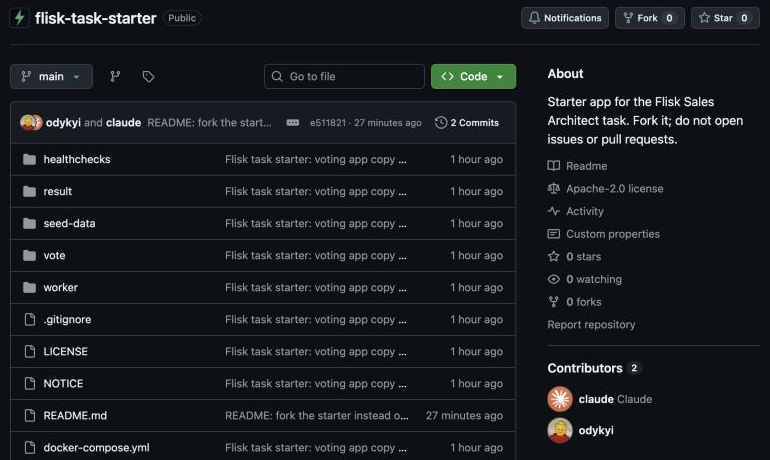
    The flisk-task-starter repository on GitHub, with the Fork button at the top right
    The starter. Press Fork, top right.
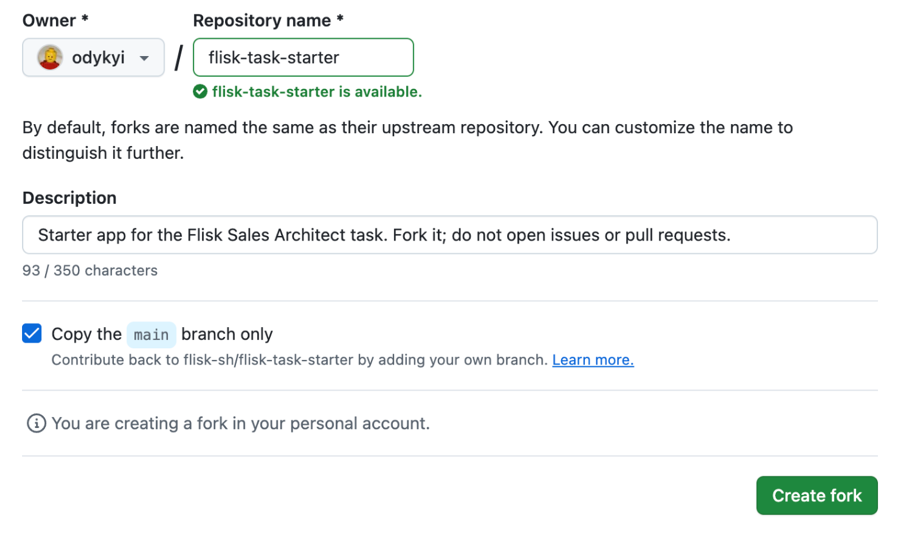
    GitHub's Create a new fork form for flisk-task-starter, with your account as owner and the Create fork button at the bottom right
    Keep the name and leave "Copy the main branch only" ticked. Press Create fork.
  2. Clone your fork.
    git clone https://github.com/YOUR-LOGIN/flisk-task-starter
    cd flisk-task-starter
  3. See the plan. Nothing is written yet. Read what Flisk could not translate: that is your first friction.
    $ npx @flisk-sh/flisk import . --dry-run
    Found 5 service(s) and 0 job(s) in ~/flisk-task-starter
    Read only: docker-compose.yml. Lines below name what was not translated.
    
      .flisk/project.json  [create Flisk project]
      …
      vote  (service, vote/)
        from:      docker-compose.yml [compose]
        build:     vote/ with Dockerfile
        port:      80 (from Compose)
        proxy:     routed through Traefik
        health:    / (assumed)
        depends:   redis
        write:     services/flisk-task-starter/vote/service.json  [create]
      …
    
    Skipped / not fully imported:
      docker-compose.yml [compose]: service "vote" keys not translated: volumes, networks
      docker-compose.yml [compose]: service "result" publishes extra container ports (9229); Flisk routes only 80
      docker-compose.yml [compose]: service "result" keys not translated: entrypoint, volumes, networks
      docker-compose.yml [compose]: service "worker" keys not translated: networks
      docker-compose.yml [compose]: service "redis" keys not translated: volumes, networks
      docker-compose.yml [compose]: service "db" keys not translated: volumes, networks
      docker-compose.yml [compose]: service "seed" has profiles ["seed"]; profiles are not enforced by Flisk
    
    Dry run: nothing written.
  4. Write it and start it.
    npx @flisk-sh/flisk import .
    npx @flisk-sh/flisk up
    The first start takes about 90 seconds. Then run npx @flisk-sh/flisk networks for the URLs: the voting page is at /api/vote and the results at /api/result. Open both.
  5. Write your README and push. Replace the starter's README.md with yours: how to start it, and a ## What was hard section. Then git add -A && git commit -m "Run with Flisk" && git push.

Deliver Your fork with .flisk/project.json, a service.json per service, the starter's LICENSE and NOTICE, and your README.md.
2

Product: the next 6 months 45 min

What: Predict what Flisk should ship by six months from now. How: Read, in this order (read only: do not comment or open anything there):

  1. docs/ROADMAP.md: what Flisk intends to do over 12 months, and what it will not do.
  2. docs/CHANGELOG.md: the Unreleased section and the last few versions. This shows what is being built now. (The GitHub releases page only lists checksums.)
  3. The open issues labelled rfc: proposals not decided yet.
  4. flisk.sh, the README, and what you learned in Part 1.

Look for the pattern: what keeps being built, and where does it lead in six months? Why: The first hire shapes the roadmap with the founder; we want to see if you understand where Flisk is going and why.

Deliver ROADMAP.md in your fork, in this shape (replace every line in capitals):

## Vision
WHERE FLISK IS GOING, IN ONE OR TWO SENTENCES OF YOUR OWN.

## Next 6 months
| Item | Who it is for | Impact | Confidence | Ease | ICE | Number to watch |
|------|---------------|--------|------------|------|-----|-----------------|
| ITEM | WHO           | 1-10   | 1-10       | 1-10 | I×C×E | METRIC        |
(at least three rows, highest ICE first: quick wins on top)

## Not now
ONE THING FLISK SHOULD NOT BUILD YET, AND WHY.

Rules

  • Contact no one. Fork the starter, but open no issues, pull requests or comments on it or on Flisk. No links to other projects' issues in your commit messages.
  • Keep LICENSE and NOTICE.
  • No .env or node_modules committed. Do the work yourself: this task is for people, not AI assistants.

How we review

The self-check gives a score from 0 to 100: it only counts what is in your fork, the same way every time. 80 or more, with a fork, no secrets, the licence kept and no contact with other projects, is ready for review. The founder then scores technical depth and product vision, 1 to 5 each. Strong submissions get a 30-minute call. The check is open: check.js, tests.

Self-check

This does not submit anything. It is only for you: it reads your public fork in your browser and sends nothing to us. Run it as often as you like, up to about 15 times an hour (GitHub's limit without a login). When it says Ready for review, submit by replying to the message that brought you this link, with your fork's URL. Start date is the day you got the link.

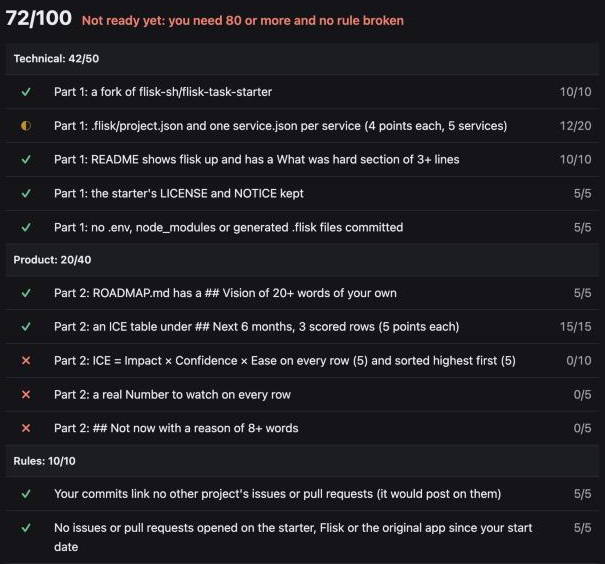
Example self-check result: 72 out of 100, Not ready yet, grouped into Technical, Product and Rules with points per line
An example result (not a real submission): 72/100. A ✓ is full points, ◐ is partial, ✗ is none. Fix those, check again.
publicpages.flisk.si@odykyiv22sourcesharePublic linkPrivate fileprivatereport